
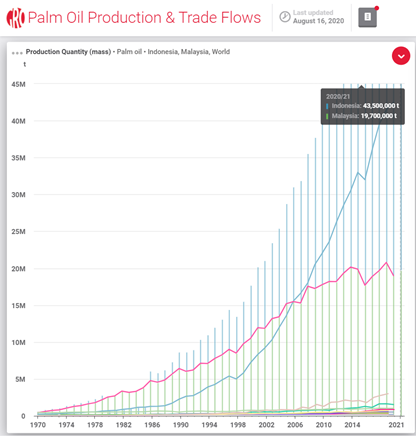
Recent challenge to fulfill the demand of crude palm oil as the most versatile and productive vegetable oil in the world is land expansion if we can not improving the yield by using the most productive genetic material and improving the agronomical practice. The world population increment and needs of renewable energy like bio-fuel will increase the demand of vegetable oils, Indonesia as the biggest producer and consumer of palm oil1) has future plan to implement palm oil based fuel by 100% made from palm oil in 2022. 2)
We have made some simple calculation regarding the implementation of 100% palm oil based fuel in Indonesia some assumption and projection based on government statements & regulation, this is our calculation: with assumption 85% Mature area & yield assumption 3.3 tonnes CPO/ha/year (Malaysia national yield from MPOB 2019: 3.46 tonnes CPO ton/ha/year), without yield increase we need 14.5 million ha of mature land in this year for fulfill the demand, then to support B40 in 2021, need 15.69 million ha of mature land., to support B50 in 2022 need 16.88 million ha of mature land, and if want to implement B/D100 in 2025 we need almost 23 million ha mature oil palm lands, which is 9 million ha need to open in 5 years period.
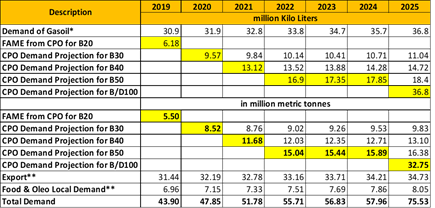
** Export, Food & Oleo Local demand based on OECD/FAO, 2019. OECD-FAO Agricultural Outlook 2019-2028, Rome: OECD Publishing, Paris/Food and Agriculture Organization of the United Nations/
The remaining land to be open for oil palm plantation in Indonesia mostly classified as marginal land, land that has low quality due to has limiting factors if use by certain utilization3), the one of marginal land is tidal wetland.
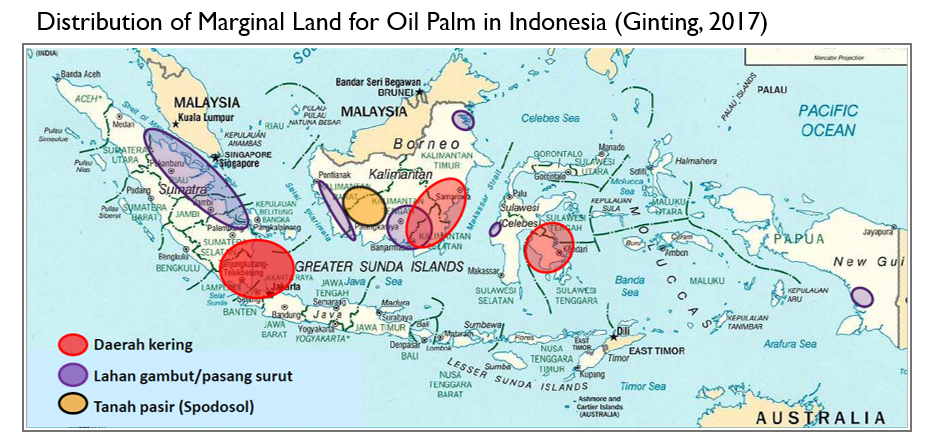
Available at: https://www.iopri.org/wp-content/uploads/2017/12/PEMUPUKAN-SAMPIT-DES-2017-Bahan-Tayangan-Kalteng-Eko-N-Ginting1.pdf
[Accessed 15 August 2020].
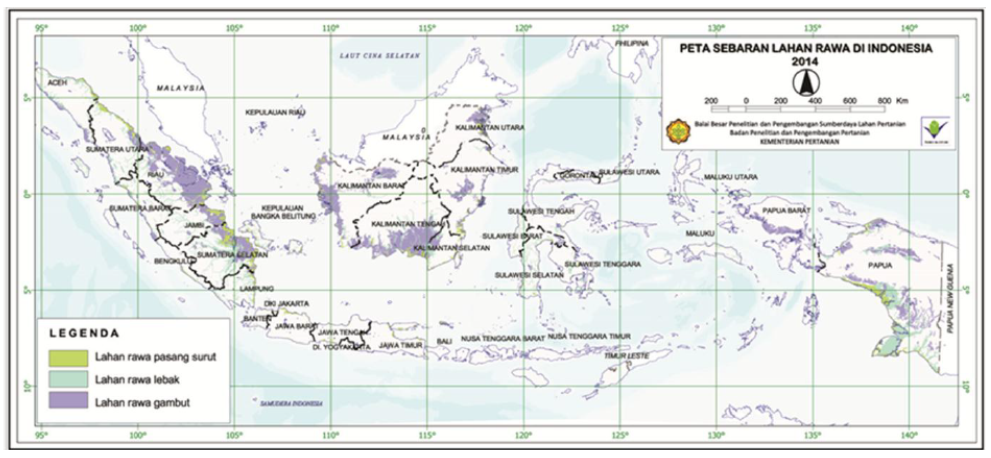
According to Balai Besar Litbang Sumberdaya Lahan Pertanian, tidal wetland distribution in Indonesia was about 8.9 million hectares, some of these area were already utilized as various commodities and has law restriction if we want to use it as oil palm plantation, but some of these area has great potential if we can manage it properly, because history record the one of major ancient civilization were made in Nile River Delta which is river delta and estuary generally in marine/fluvio-marine landform that has tidal wetlands.
The major limitation that usually found in tidal wetland if we want to use it as oil palm plantation are:

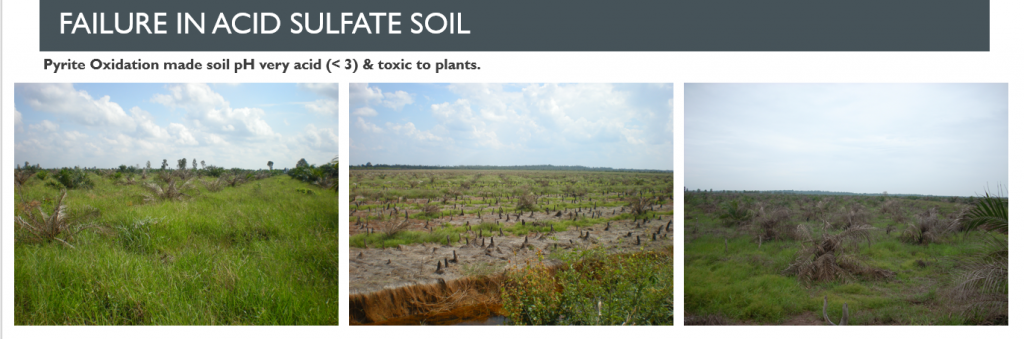
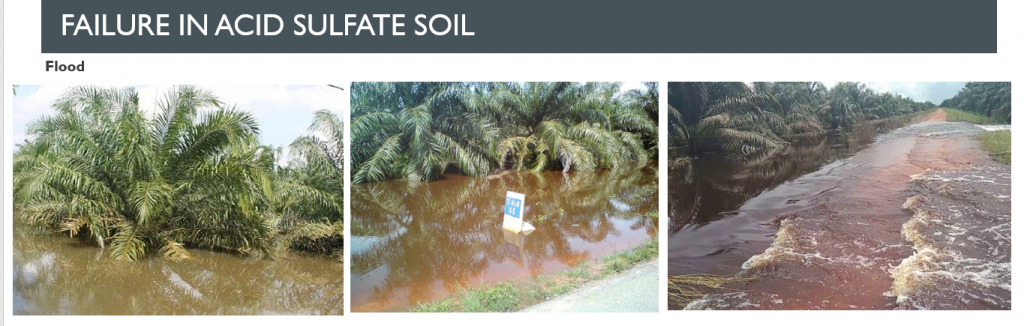
What should we do? does the tidal wetland can be productive land for oil palm plantation?
We have general recommendation, but we should considered that this general recommendation can not generally applied in your location, there is no ‘master solution’ because the agro-recommendation should be site specific. The general recommendation is to create proper planning four your tidal wetland by doing soil survey, land suitability assessment & topographic measurement to make water management & estate design planning.
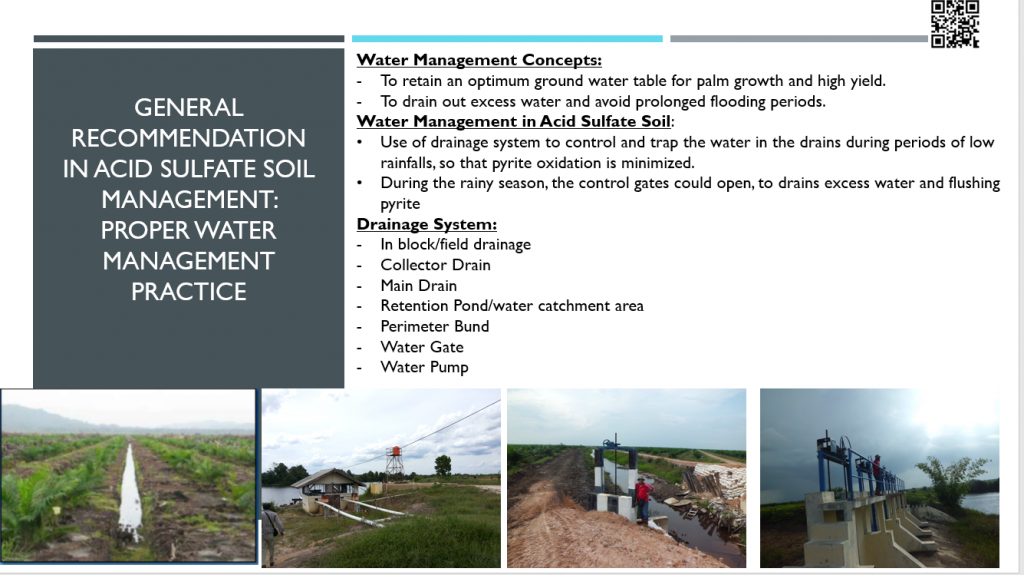
Following conditions is required before opening tidal swamp for oil palm plantation4):
a) Materials for “bunding” is available
b) If (a) is unavailable, then the “n” value of the soils should be less than 0.7
c) Most of the land boundary should not be on erosional surface
d) The land should preferably be higher than the sea or river level at low tides
e) Rainfalls should be sufficient (> 1700 mm yr-1) to allow flushing and leaching of salts/pyrite layer
f) Land area must be sufficiently large to dilute the cost of reclamation and maintenance to economic level
- Drainage management – water table maintained between 45 to 60 cm from soil surface
- Periodic flushing – remove acidity (min. 2 to 3 times per year)
- Liming was ineffective to control acidic conditions in acid sulfate soils as (i) the effect of liming was short-lived and (ii) required a repetitive/periodical application rounds of liming which was expensive and labor intensive.
- Application of bunch ash or boiler ash could be effective.
- Preventing further intrusion of sea or brackish water of more than 1,000 mmhos/cm or 1,000 dS/m into the land is central to reclamation of saline soils.
- Construction of BUND.
- Retain the available mangrove belt to provide additional protection against erosion by tidal current.
- Upon completion of bund construction, a DRAINAGE NETWORKS comprising main and collection drains must be laid down to reduce the water table and allow for subsequent flushing of the drains.
- Sufficient WATER GATES and WATER PUMPS to remove the water trapped in the land.
- Bund maintenance to prevent seepage and leakage.
Proper Water Management has proven in increasing FFB production 25 to 30 t/ha/year5).
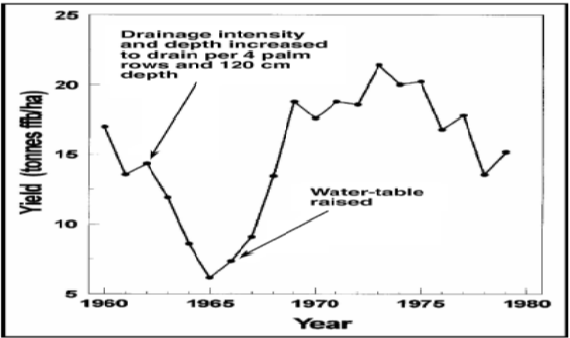
With proper drainage system in tidal swamp oil palm could produce 25 ton FFB/ha/year6). 5 years old oil palm production in tidal swamp (acid sulfate soil) in South Sumatera with proper land management can reach 18.27 ton TBS/ha/year7). Yield in tidal swamp in Carey Island, Peninsular Malaysia in 5 years oil palm could reach 19 – 22 ton FFB/ha/year8).
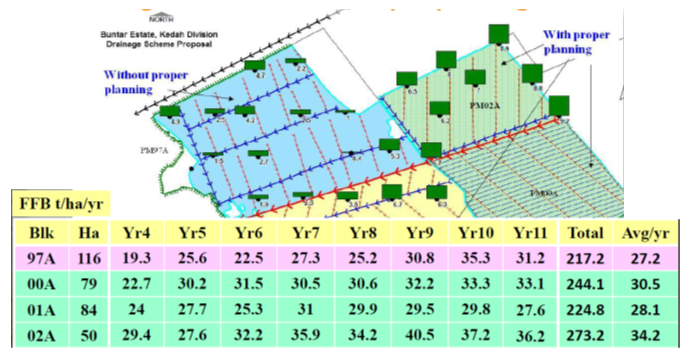
With proper management of acid sulphate soils in the 1st generation oil palm planting and at replanting, the yield performances of 2nd or 3rd generation oil palm plantings commonly exceeded the previous generation with reports of FFB yields over 20 tonnes/ha/year in the first year of harvesting and over 30 t ha-1 yr-1 during the peak yielding period9).
This article was presented on Jakarta Planters Club Webinar 3rd series 20 August 2020.
Download presentation material.
For further information please contact us at info@kaliandra-lestari.com